Technology can help water providers enhance operations and increase efficiency. Water providers use technology to monitor water use, detect leaks, and manage water quality. Advanced metering infrastructure, or AMI, is one technology that can benefit water providers and the people they serve.
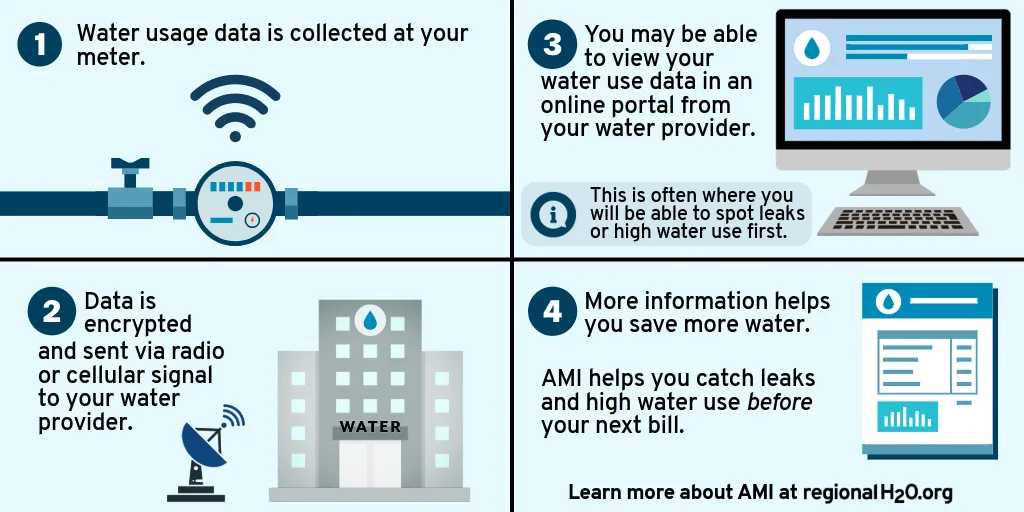
AMI refers to a system of smart water meters, communication networks, and data management systems. The meters send water usage data from a home or business to a water provider using radio or cellular technology. Many regional water providers use AMI technology or plan to transition to AMI in the future.
This page includes customer benefits of AMI, how AMI helps your water provider, frequently asked questions, and additional resources.
More information helps you save more water
One of the greatest benefits of AMI is that customers can catch leaks early, before their next bill. With AMI, water meters continuously read and relay data. This can reveal increased water use from a leak. Finding and fixing leaks sooner helps customers waste less water, reduce damage to their homes, and save money.
Even if you don’t have a leak, having more data can help you see if you’re using more water than you intended or expected. Your sprinkler might be running five days per week instead of the two days you thought. You might notice that long showers are adding up. Or, you notice that water is still flowing despite nobody being home. AMI makes it easier for you to see how much water your household is really using.
AMI helps water providers better serve their customers
The use of AMI provides many benefits for customers, and it’s great for your water provider too. A key benefit of AMI for water providers is that customer meters don’t need to be manually read. While this sounds obvious, some of the advantages are more subtle.
Benefits of AMI include:
- reducing errors and speeding up data collection
- providing water providers with critical information to respond to water emergencies quickly
- providing customer service with the best information to help you when you call
- reducing costs and equipment associated with meter reading
Frequently Asked Questions
How does AMI work?
AMI uses a system of smart meters that wirelessly send water usage data to your water provider. A small antenna in your water meter uses a low-power radio or cell signal to transmit information on how much water is passing through your meter—from the public water system to your home’s plumbing—and sends that information to your water provider.
What is "continuous consumption"?
When it comes to water use, "continuous consumption" means that water is flowing without stopping. If water is flowing nonstop while no one is home or everyone is sleeping, that could mean you have a leak.
What tools can I use to detect leaks at home?
Contact your water provider to see if you can opt into "leak alerts”. You may be able to receive notifications of continuous consumption. And whether your water provider uses AMI or not, you can use your water meter to check for leaks at home.
Do I have an AMI smart meter?
Many regional water providers already use AMI, and some are planning to use it in the future. It can take many years and a lot of funding to complete an AMI project. This process includes planning, replacing old meters, integrating new technologies, and training staff before bringing the system online.
If you receive water service from the cities of Lake Oswego, Gresham, Sandy, Scappoose, or Sherwood, or from Clackamas River Water, Oak Lodge Water Services, or Raleigh Water District, your home has an AMI smart meter. If your water comes from the Portland Water Bureau, Rockwood Water PUD, or Sunrise Water Authority, your water provider is working to bring AMI online.